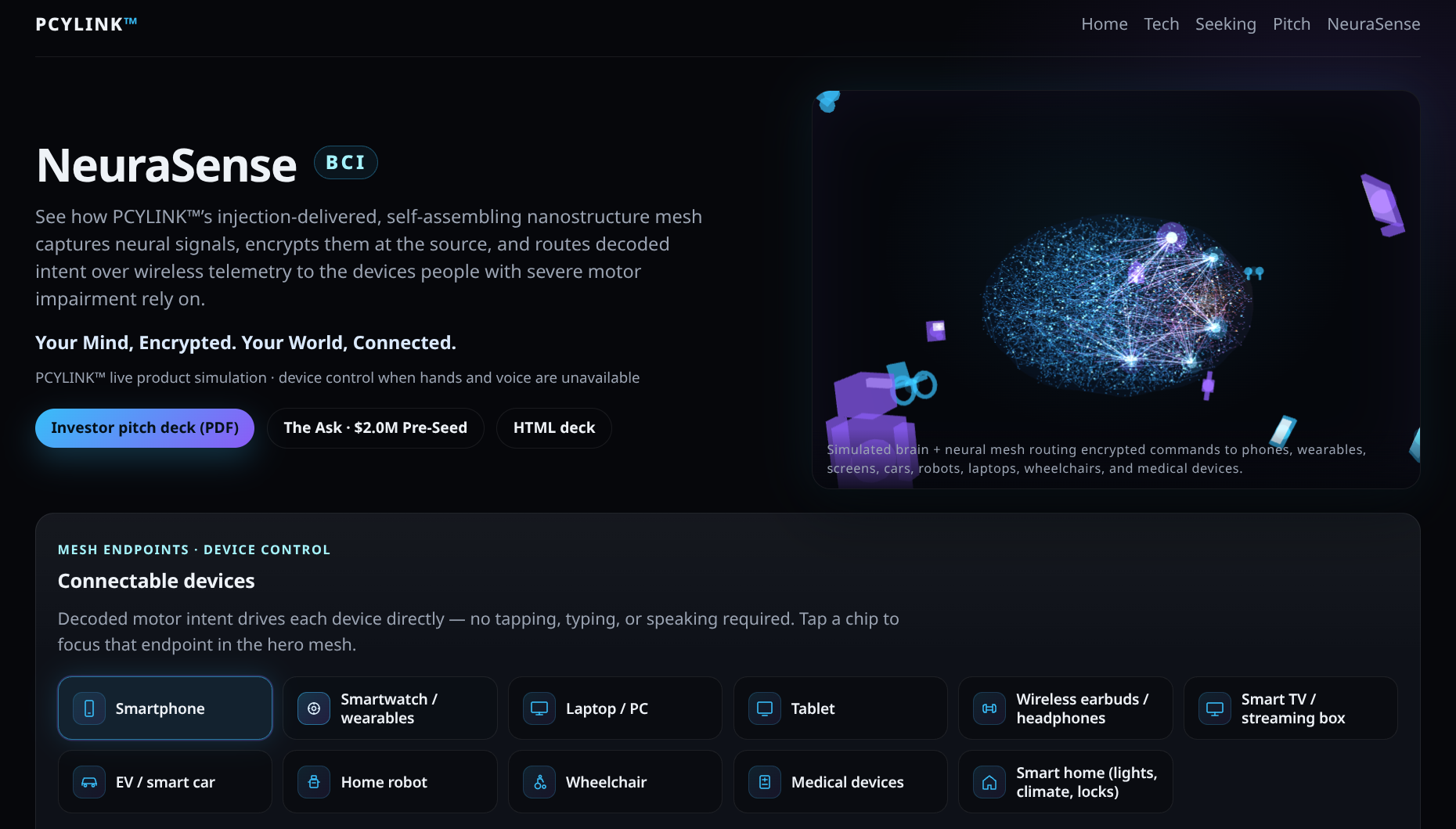
PCYLINK is building an injection-delivered, self-assembling nanostructure mesh that captures high-fidelity neural signals, encrypts them at the source, and routes motor intent wirelessly to external devices — restoring communication and control for patients with severe motor impairment, without open-skull surgery.
Healthcare systems and payers waste over $10 billion annually managing severe paralysis across 300,000+ U.S. patients through high-risk $150,000+ open craniotomies and prolonged intensive care complications.
Traditional BCIs require drilling through the skull (craniotomy), with significant risk of infection, chronic inflammation, and scar-tissue buildup.
Open-skull neurosurgery costs hospital systems and payers over $150,000 per procedure, limiting accessibility to only extreme edge cases.
Most neural recording systems prioritize signal over security, leaving raw neural data exposed to privacy risks and potential attack vectors.
PCYLINK delivers high-fidelity brain-computer interfacing through a minimally invasive, non-craniotomy delivery system with hardware-grade source encryption.
Replaces open-skull surgery with a targeted micro-injection, drastically reducing infection risk, tissue trauma, and patient recovery time.
Lowers procedure complexity and hospital stay times, cutting overall delivery costs by more than 60% compared to traditional craniotomies.
Encrypts neural signals at the biological interface before transmission, designed to prevent unauthorized interception.
PCYLINK captures high-fidelity neural signals through a minimally invasive interface, encrypting and routing data directly to external systems without open-skull surgery.
Patients regain lost physical agency and high-speed digital control through an outpatient-style intervention that bypasses the severe risks of invasive brain surgery.
An interactive simulation of the PCYLINK platform: a neural mesh decoding intent and routing encrypted commands to personal, mobility, and medical devices.
A live product surface investors and clinicians can explore today, ahead of preclinical data.
Micro-mesh prototypes and delivery mechanics.
In vitro testing against defined benchmarks.
Non-primate studies of delivery and signal capture.
Lock the regulatory path toward an IDE.
PCYLINK converts a $10B annual healthcare drain into a $15B clinical beachhead, expanding into a $38B global neurotechnology market by 2032.
PCYLINK eliminates the surgical trauma of Neuralink and the channel-count limits of Synchron by utilizing injectable nanomaterials with hardware-grade encryption.
| Capability | Neuralink | Synchron | PCYLINK Advantage (Target) |
|---|---|---|---|
| Surgical Invasiveness & Delivery | Highly invasive. Requires a craniectomy (a coin-sized section of skull removed) and robotic insertion of penetrating electrode threads into the cortex. | Moderately invasive. Endovascular catheter delivery via the jugular vein (stent-based), plus a subcutaneous chest pocket for the telemetry unit. | Minimally invasive targeted injection. Zero surgical bone removal, zero vascular catheterization. |
| Signal Density & Cellular Integration | High channel count (1,024 electrodes on flexible threads), but penetrating electrodes provoke a tissue response; thread retraction cut effective electrodes in the first patient. | Lower channel density (16 electrodes), restricted to recording from within large blood vessels outside the actual parenchyma. | Distributed nanoscale mesh. Self-assembles directly at the neural cellular level, enabling high-resolution capture without rigid tissue displacement. |
| Long-Term Biocompatibility & Power | Small rechargeable battery inside the skull-mounted implant; requires routine inductive recharging through the scalp. | No implanted battery; chest-implanted telemetry unit depends on an external inductive power unit worn over it. | In situ biochemical energy harvesting. Powered by native biological substrates, eliminating bulky battery hardware and chronic tissue-strain. |
| Architecture & Data Security | On-implant spike detection and compression, then Bluetooth to an external app for decoding. | Raw signals relayed over a custom RF link from the chest unit; decoding happens off-body. | Hardware-grade source encryption. Telemetry is encrypted directly at the biological interface, protecting neural privacy at the origin. |
| Neither publishes an end-to-end neural-data encryption design. | |||
PCYLINK has completed in silico computational modeling and IP groundwork, positioning the company to transition directly into wet-lab bench synthesis.
Completed theoretical simulations modeling nanomaterial self-assembly dynamics, molecular transport, and baseline electrical conductivity in simulated neural environments.
Modeled in situ bio-electrochemical power generation to calculate power draw and thermal dissipation limits for the internal network.
Filed core trademarks (PCYLINK™) and drafted provisional patent claims covering injectable self-assembling neural interfaces and bio-source encryption.
Designed comprehensive in vitro and non-primate in vivo testing protocols alongside clear FDA pre-submission milestones.
In Silico (Simulation & Theoretical Architecture).
In Vitro (Physical Nanomaterial Synthesis and Bench Biocompatibility Testing).
In Vivo & FDA Q-Sub (Animal Model Signal Capture and FDA Pre-Submission).
PCYLINK is led by proprietary systems architecture and supported by an immediate roadmap to seat world-class neuroengineering and clinical leadership.
Lead architect of PCYLINK neural networking protocols, encrypted brain-computer interface architecture, and proprietary signal transmission thesis. Spearheading initial IP filing, investor formation, and technical development roadmap. Directed PCYLINK’s in silico simulation and modeling program.
Leads nanomaterial formulation, characterization, and electrical conductivity verification for the self-assembling mesh.
Dedicated to baseline bio-electrical signal transmission testing on benchtop neural tissue cultures.
Sponsored wet-lab access for nanomaterial synthesis and in vitro cell-culture biocompatibility assays.
Chief Scientific Officer / Lead Neurobiologist · VP of Biomaterials & Neural Engineering · Lead Regulatory & FDA Strategist, for in vivo validation and the FDA pathway.
PCYLINK enters the market via established neurotechnology reimbursement pathways, monetizing through high-margin medical device sales and hospital procurement.
Focus strictly on severe motor impairment and paralysis restoration, pursuing FDA Breakthrough Device designation and expedited review pathways.
Modeled after proven neuromodulation billing pathways (such as Deep Brain Stimulation and spinal cord stimulation), covered by Medicare and private insurers.
Tier 1 neurosurgical centers and specialized rehabilitation hospitals that already purchase and deploy implantable neural hardware.
PCYLINK requires ~$28M in cumulative capital through first commercial revenue, across three development phases, to reach FDA PMA approval via the Breakthrough pathway and scale to $20M in commercial procedure revenue by Year 5.
| Year · Phase | Operating Burn | Revenue | Focus |
|---|---|---|---|
| Year 1Pre-Seed PhaseThis round | $2.0M | $0 | Nanomaterial formulation, in vitro benchtop biocompatibility, and utility patent portfolio. |
| Year 2Institutional Seed Phase | $6.0M | $0 | Non-primate in vivo animal models, signal-to-noise optimization, and FDA Q-Submission / IDE filing. |
| Year 3Series A / Clinical Trials | $10.0M | $0 | First-in-human feasibility safety study (10–15 patients) and IDE trial execution. |
| Year 4Early Commercialization | $10.0M | $3.0M | FDA PMA approval (Breakthrough pathway), early access programs across 3 pilot neurosurgical centers (60 injections @ $50k). |
| Year 5Scaled Commercial Adoption | $12.0M | $20.0M | Expanded commercial rollout across 20 Tier-1 hospital networks (400 injections @ $50k, 88% gross margins). Reaches operating profitability in Year 5. |
| Years 1–4 | $28.0M | $3.0M | Cumulative operating burn through first commercial revenue ($2.0M + $6.0M + $10.0M + $10.0M). |
Blended price per implant system, reimbursed via established neurotechnology pathways.
At early production, driving 88% gross margin.
Across Pre-Seed, Seed, and Series A rounds (Years 1–4 operating burn).
Reaches operating profitability in Year 5.
PCYLINK is raising a $2.0M Pre-Seed Round to complete physical nanomaterial synthesis, benchtop validation, and initial in vitro proof-of-concept over 18 months.
Nanomaterial formulation, characterization, electrical conductivity verification, and in vitro cell-culture biocompatibility assays.
Sponsored university lab access, principal materials scientist, and dedicated electrophysiology researcher.
Formal conversion of provisional patents to PCT/utility filings, and initial regulatory engagement strategy.
Confirmed in vitro self-assembly of conductive nanostructures in simulated bio-environments.
Validated non-toxicity and baseline bio-electrical signal transmission on benchtop neural tissue cultures.
Filed utility patent applications covering the injectable self-assembling mesh and biochemical energy harvesting.
Direct biological proof in hand, unlocking an institutional $8M–$10M round for in vivo animal models and FDA engagement.
$2.0M Pre-Seed · In vitro proof-of-concept · Utility patents · 18 months
Partner with PCYLINK to bring minimally invasive, encrypted neural interfaces to patients with severe motor impairment.